5 December – Lunch of Celebration By Paul Neazor
If these newsletters have been off the airwaves in the last couple of weeks, it is not because the club has run out of stories to tell. Instead, it’s because we’re getting ready to celebrate a rather large one, featuring many of the most dedicated individuals to have been involved with Ponsonby over the last half-century and more. With all the digging into the past that’s been going on over recent years, many previously unrecorded achievements have come to light. One concerns our centurions, those individuals dedicated enough and skilled enough to represent the club’s top team more than 100 times. In May we acknowledged those who had reached the barely credible total of 200 games; now it’s time to celebrate the 100-gamers. These days, of course, a centurion gets presented with his or her blazer at the first opportunity but back in the day nobody kept records so while people knew the guys who had ‘been around for years’ what they had actually given the club remained something of a mystery. With Life Members it’s simpler. They are elected at the AGM, and their record is described in some detail. Since only a few have been leading players there isn’t that lack of information for that reason, but because a lot are modest about their contribution you’d think they turned up to watch the odd game and little more. And that is miles removed from the truth. So, just to whet the appetite, here are the people we’ll be celebrating on 5 December. I’ll start with the players.  |
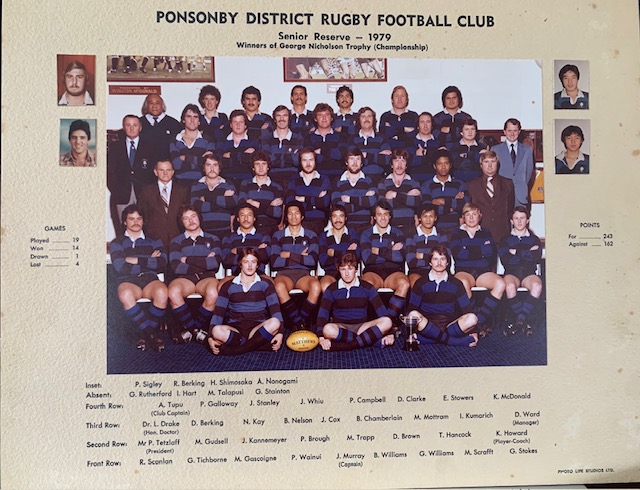 |
The 1979 Senior Reserves photo included a large of Life Members and 100-gamers - Grant Rutherford (both), Pat Galloway (100 matches), Joe Stanley (both), Dr Lloyd Drake (Life Member), Percy Tetzlaff (both), and Bryan Williams (both). As well there are three players on the 100-match bubble whose records are being comprehensively searched now - Maurice Trapp, Bruce Nelson and Ken Howard.
|
Our earliest living centurion is Ken Williams, whose scoring feats have been recently acknowledged in these newsletters. A bruising, powerful finisher with top-end toe, Ken may have been overlooked as his contemporaries got more recognition but his contribution was significant. He retired as sixth on the club’s try list, and Ken Going’s rating as the hardest winger he ever tried to tackle which – coming from such a shattering tackler as Going was – means something. Ken won’t be able to make the lunch as he’ll be overseas, but will get his blazer early in the New Year, when there will be another function for those who can’t make this one. |
The great All Black lock Peter Whiting was surprised when contacted and advised of his record for Ponies, since he said: ‘I couldn’t even begin to count the number of games I’ve played for Ponies.’ Well, that total is around 150 and it’s a fair bet he wasn’t shaded in the lineout too often; he was, by universal consent (even the Brits agreed, which was as rare as winning the lottery) that he was the best lock forward in the world in the early 1970s. Peter, who lives in Wanaka these days, won’t be able to make the lunch but we do remember his extraordinary ability and commitment. |
There’s a group of three who have contributed so much both on and off the field that they played 100 Senior matches and were elected Life Members; that combination of devotion has only been achieved by 11 players in more than 150 years. They were, for a time, team-mates and not surprisingly drove their sides to the top; all had multiple Gallaher Shield wins on the field and two added championships from the coach’s bench. |
In order of their first appearance, they are Joe Stanley, Grant McCurrach and Jack Huch. Joe was the rock in half a dozen championship backlines, although All Black duties and an increasingly long rep programme took him away more frequently with each passing year. His sensational passing skills were among the main reasons Ponsonby scored so heavily during his career, and his brick wall defence was a significant factor in the opposition scoring so little. His final match total is around 130. Since ending his playing career he has been involved in a number of ways and many club functions have benefitted from his skill at organising and his wide network of rugby contacts. His Life Membership, awarded in 2018, was thanks for many jobs well done and, as ever, appreciation for those still ahead. |
Grant McCurrach is one of the links in an extraordinary chain of Ponsonby halfbacks who for more than 40 years basically kept the job in six pairs of hands. Preceding him were Trevor Paterson, Dave McIntyre and Lin Colling, and after came Paul Norwood and Amosa Amosa; all six played more than 100 matches in blue and black. Among many accolades McCurrach has two in particular; he captained the unbeaten 1986 team, which has to rate as one of the club’s best ever, and coached the 1990 side which annihilated Marist, 32-3, on a flooded field in the Gallaher Shield final. His final match total is in the 140 range. After ending his playing days he became heavily involved in keeping the club’s finances sufficiently buoyant – and it was a difficult task – to stave off foreclosure when that word was touted rather too often for comfort, before becoming one of the Foundation Trustees. His 2020 Life Membership probably could have been awarded any time in the preceding decade, so large has his contribution been. |
The third member of the trio is Jack Huch, whose skills as a deadly finishing winger put many points on scoreboards around town in his playing days. These began when he was still at school but was too old for 1A, so he played for Ponsonby and then Auckland instead. He played test rugby for Samoa as a young man, being one of the first picked who had spent significant time overseas, thus missing the mid-1980s powerhouse Ponsonby teams. A decade after his first selection he was back and quickly showed he had lost none of his finishing skills, eventually posting 65 Senior tries. Since retiring he has proved a coach of rare merit, winning championships while building teams to play exceptional rugby. His ability to mentor young players is second to none, and his many Ponsonby mates can’t understand how Auckland overlooked him when his name went forward for rep jobs. His 2011 Life Membership says his club knew all these things years ago. |
The remaining Centurions were all major contributors to the great teams that dominated Auckland rugby in its greatest years. They are, in alphabetical order, Herati Matapo, Petaia Nee Nee, Paul Norwood, Mike Turner and Levi Vao. The only thing missing between the five is height in the lineout, because they had the rest of rugby’s skills well under control. |
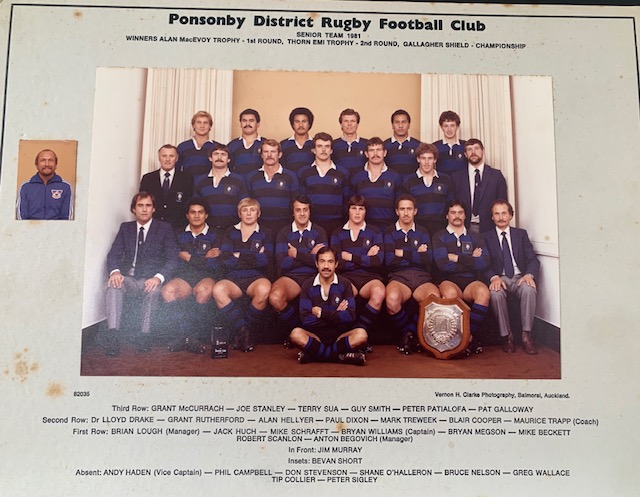 |
The Gallaher Shield-winning 1981 Senior side was chock-full of match centurions - Grant McCurrach, Joe Stanley, Guy Smith (200), Peter Fatialofa, Pat Galloway, Grant Rutherford, Jack Huch, Bryan Williams (200) and Andy Haden (200) all turned out at least 100 times in the blue and black hoops. And it wasn't short of Life Members either, since McCurrach, Stanley, Dr Lloyd Drake, Rutherford, Brian Lough, Huch, Williams and Haden all received that honour in due course.
|
Matapo was very similar in style to Joe Stanley and together they were a formidable midfield combo. Anyone taking them on knew they were in for a difficult day, and probably only Frank Bunce looked forward to those clashes since he was another cut from the same cloth. Matapo was a try-scorer, although he never put up huge season totals; that said, most backs would be happy with his career tally of 37. Herati would have been a shoo-in for a Double Centurions blazer if we hadn’t lost him to Mt Roskill for three years, since his Ponsonby match count is 173, one of the biggest among those who didn’t actually reach 200. Levi Vao, who took over in those years, had been around for a while but played second fiddle when the main duo were available, and filled either berth when it was his time. He was a try-scorer; in 116 matches he dotted down 48 times, good going for anyone, but never neglected his outsides either. Like all Ponsonby midfielders of the 1980s and 1990s he was solid on the tackle, and getting through that midfield was a test of courage as much as skill. Possibly underrated because of the galaxy of talent all around, Vao was one of the must-have men in one of Ponsonby’s greatest eras and was part of five Gallaher Shield winners. |
Cruising into the backline outside this formidable midfield phalanx was Petaia Nee Nee, one of the best attackers the club has had. He finished well up the try list every year, posting five double-digit hauls and two others of nine. He had a finely honed understanding of where to be and when to be there, which meant he retired as Ponsonby’s all-time try-scoring leader (91). Ross Thompson equalled that figure a couple of years later, but it remains unbeaten 30 years on. As with all this group of five, a rep jersey was hard to come by simply because of the sheer weight of talent in town. Nee Nee, who finished with 146 matches for the club, would have bolted into a rep side almost any other time in the last 50 years. |
Paul Norwood was Grant McCurrach’s successor at halfback, and on the list of halfback centurions. His 107 matches covered nine years and five championships, while his running game – the main difference between him and his predecessor – netted 31 tries. He had to be good since about the time he started Mike Elliott appeared on the scene and remained a strong challenger for the starting spot for years. In those days of no free substitutions there was no chance of one bowing to the other, since they might not get back in the starting XV for a while. |
The only forward in this group, Mike Turner was particularly durable and almost impossible to get out of the number 2 jersey after All Black John Mills returned to Canterbury. Turner’s most famous moment in his 175-match career was when his kick in a penalty shootout won the Gallaher Shield semi-final against Waitemata in 1975 (he had the good sense to never take another kick during the rest of his career), and his most famous photo came in the dressing rooms in 1990; long after the final whistle the captain, still in his saturated jersey, was just sitting, clasping the Shield. Two strong men with sharp chisels wouldn’t have got that smile off his face in a week. After he finished playing he coached the team to a Gallaher Shield win, which came slightly against the odds and was more noteworthy for that. |
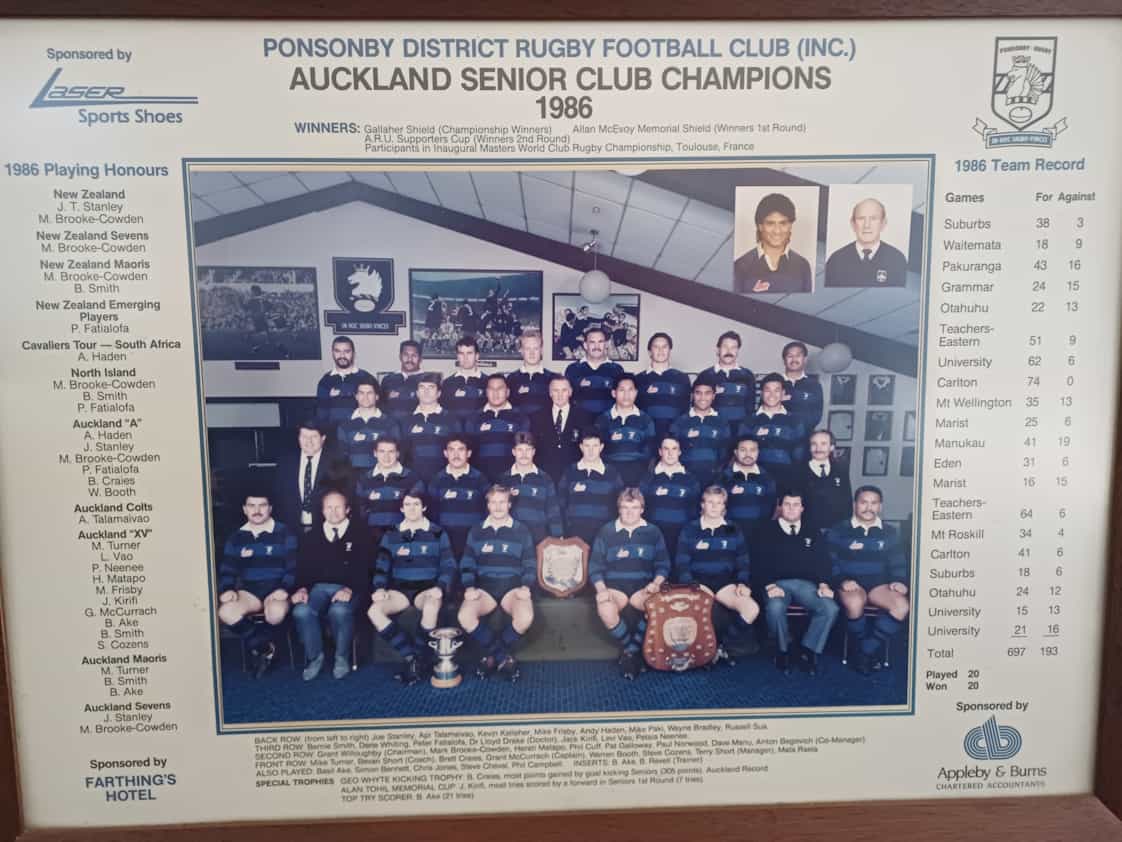 |
The 1986 Senior team ranks among the club's finest, winning the Gallaher Shield after completing a 20-from-20 season. The ten match centurions in the group are Joe Stanley, Andy Haden, Peter Fatialofa, Levi Vao, Petaia Nee Nee, Herati Matapo, Pat Galloway, Paul Norwood, Mike Turner and Grant McCurrach.
|
There are other centurions who haven’t been contacted yet, and a small group whose career figures suggest they’re right on the 100-match bubble without provably being over the line. Ongoing research will, with any luck, clarify those figures in time for a second presentation in early 2026. |
There are two international players among the number – husband and wife duo Eddie and Sandra Ioane – with Eddie playing for Western Samoa and Sandra for the Black Ferns. Sandra was one of the earliest Fillies and would probably be looked at as a blindside flanker these days rather than the lock she was, since she had speed, read a game well and had that hard-nosed attitude all good flankers need. Her off-field contribution was particularly notable when she oversaw the burgeoning Junior club, dealing with all the queries and quibbles that go with the territory. To do that once is an effort; to make a habit of it is a challenge, and the kids were in capable hands. Western Samoa test man Eddie, indisputably a lock, also got involved with Junior rugby once he’d played out his overseas contracts – not surprisingly as his own two boys were starting to make names for themselves – and carried on in a variety of roles for years. He served a term as President between 2017 and 2019, timing his run to have left office before Covid struck and made a mess of a couple of years. He’s been a strong voice on the rugby committee for some time, and is a man close to the beating heart of the club. Both Sandra and Eddie were made Life Members in 2018. |
|
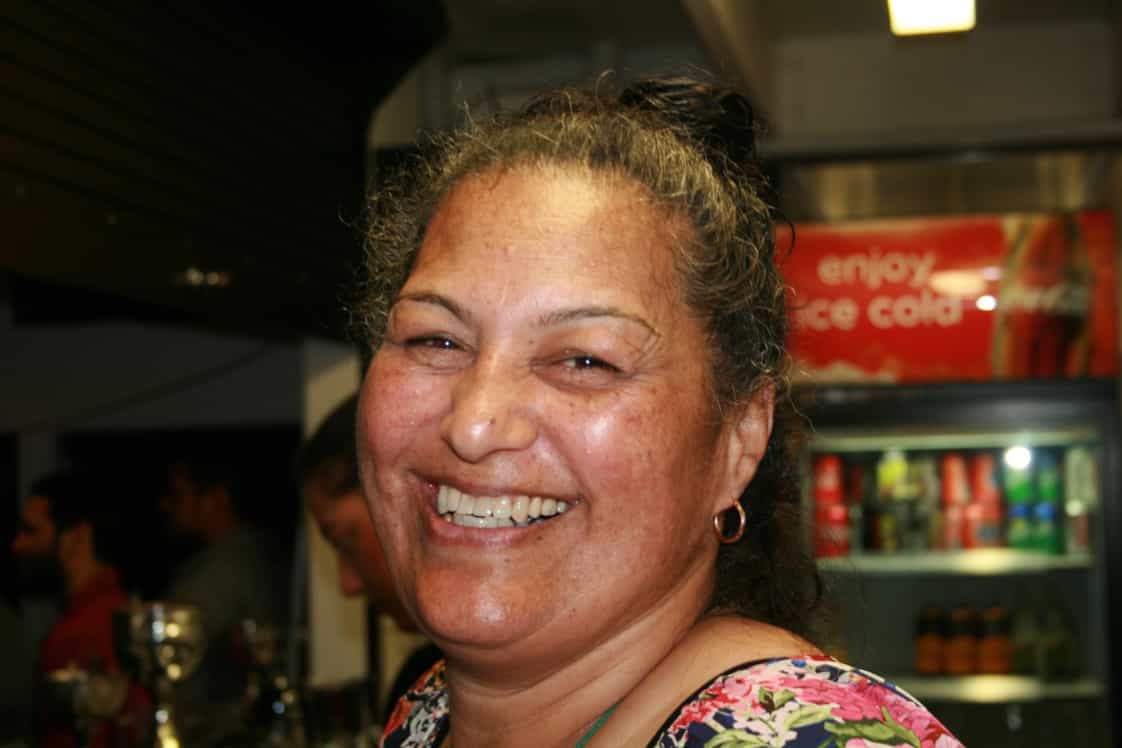
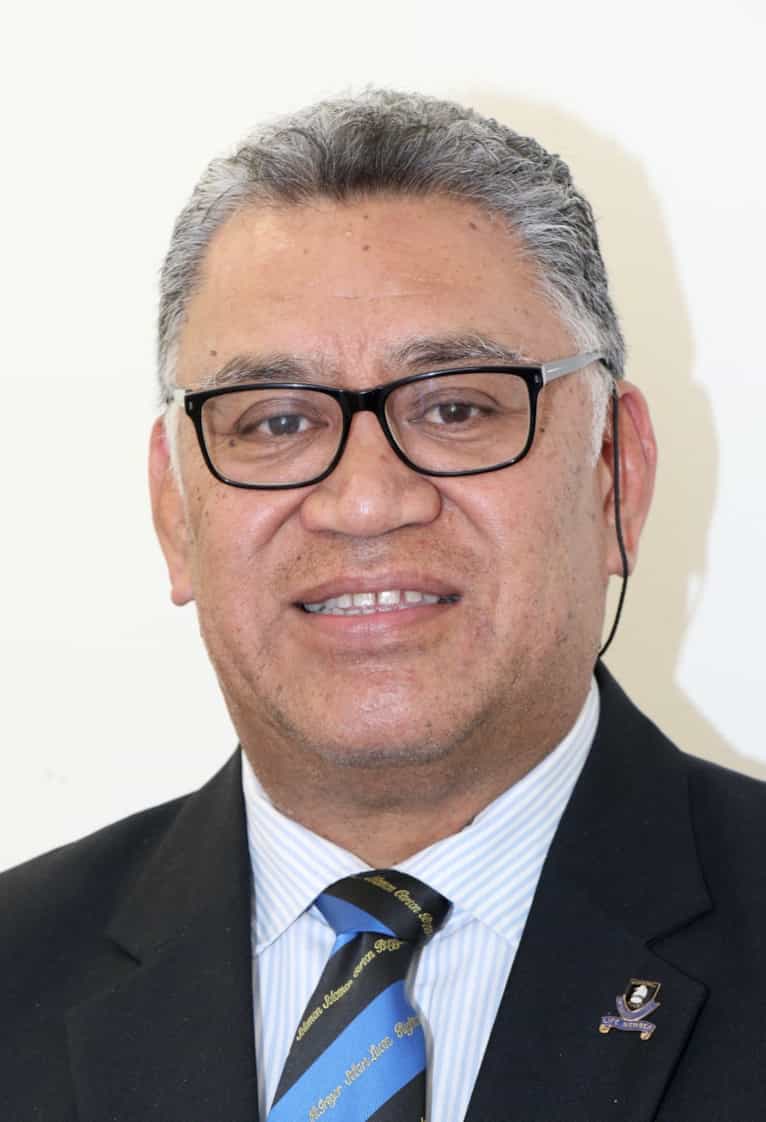
Sandra Ioane, who kept her sanity while keeping the Junior section well in hand (it can be tricky to do both). Eddie Ioane, a strong presence on the rugby committee for years and served a popular term as President.
|
Dave Atkins, the current Treasurer, was close to his 100-game blazer but shonky record-keeping for a couple of seasons meant he had no idea how close he was when he called it a day – and he was only a handful short. Since then he has, through the design firm he owns, has been a significant sponsor – many of the banners and poster boards you can see in the lounge and dressing rooms are produced by his team – and he has also done a sterling job with Annual Reports. He took over as Treasurer in 2025 when the position became vacant shortly after the AGM and, familiar with handling large sums of money, has steered the good ship Ponsonby into calm financial waters. |
|
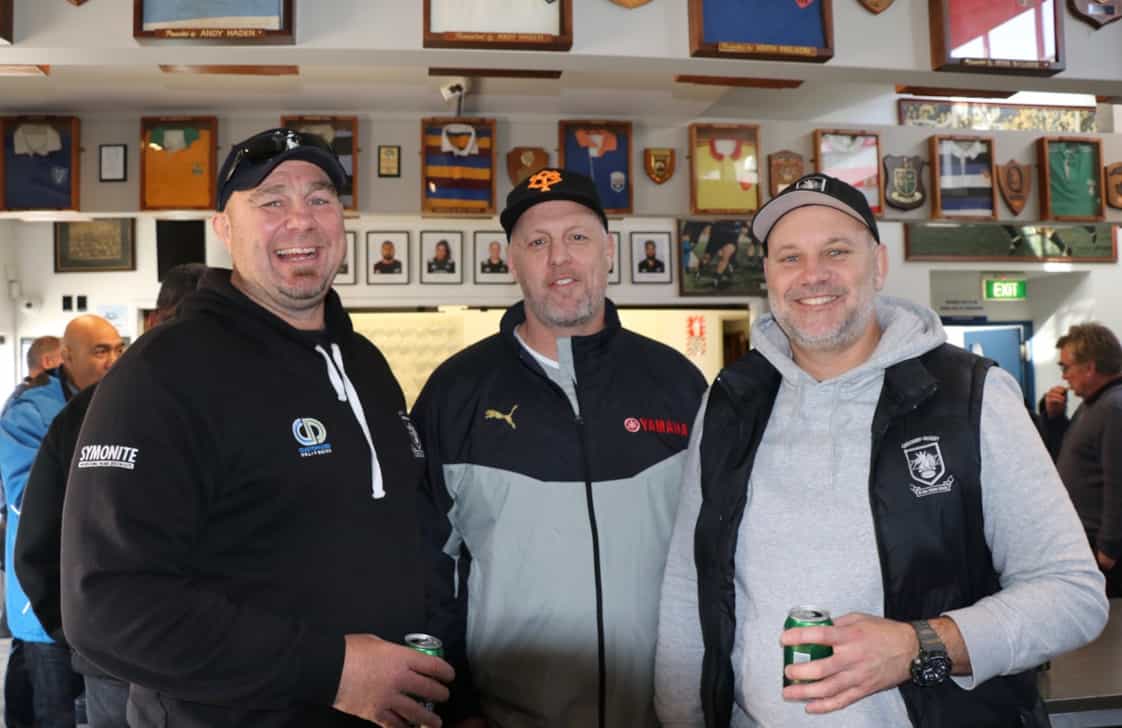
A number of the Life Members first came to Ponsonby through the Junior club; you can count Craig Partridge (elected 2007), Bob Banks (2016), Chris Clews (2019), Hugh Heeney (2020) and Geoff Buchanan (2022) in this group. It’s extraordinary how many originally began with the Kelston wing; before Craig, for example, Athol Rickard and Max Mains were very active out west and Partridge was cut from the same cloth. Archibald Park being what it is today has a lot to do with his efforts 20 years ago. The fact so many who became involved in the club through their kids have stayed long enough, and have done enough, to be recognised as Life Members is a tribute to many things apart from individual willingness to give freely to the club, not least of which is the club’s ability to see talent wherever it exists and use it where it fits best. Almost all this group have eventually gravitated to the senior committee – Clews chaired it for 12 years – but Buchanan remained with the Juniors and for years has been the man who knows all about everything in that section of the club. |
There are others whose particular skills were very important over long periods: Neil Wolfgram is, for example, a fine organiser who, given a set of conditions, a start line and a deadline, would get things organised meticulously and on time every time. John Ward, a former Club President, had a nice way with people and, with wife Margaret, became a vibrant part of the President’s scene for years. Both were excellent organisers and played big parts in the 125th Jubilee; Margaret’s passing not long after that successful event was a blow felt by the whole club. Lawyer Peter Thorp, who did a long stint in the Chair, has contributed plenty to both the lease at Western Springs (his foresight has protected the club on several occasions) and the formation of the Trust after the sale of Blake Street; he is another expert planner and a first-rate delegator who always seemed to pick the right person for any job. Dennis Mansfield, who came into the club as a team manager, was also the first to maintain records on a digital platform and keep track of any number of things. Those who proudly wear their 40-game and 100-game blazers have a lot to thank him for, since without his efforts that would probably never have started and without Dennis and Terry Hodges, who took over from him, current records would be all but non-existent. He’s also captured thousands of Ponsonby moments through the trusty lenses of a variety of cameras, and the club again has a record it wouldn’t otherwise have kept. And last, but by no means least (he’s there only because someone has to be Tail-end Charlie) is Brian Lough, organiser supreme for lunches and events, a former player of Senior standard and a rugged hombre to boot. One of the things he’s proudest about in his Ponsonby career is that he proposed Bryan Williams for Life Membership in 1983; the decision to elect him drew a bit of flak from other clubs but Brian always said: ‘It’s not how long, but how much.’ |
Every person being presented with a blazer at this lunch has given plenty, and for a long time to boot. |
|

Join Us for This Special Celebration We warmly invite our Ponsonby community to join us for this very special luncheon on Friday 5 December. Seats and tables are now available for purchase, and we would love to see our members, families, supporters, past players and friends come together to honour those who have given so much to the Blue & Black. This is a rare opportunity to celebrate our Centurions and Life Members in one place, share stories, reconnect, and be part of an afternoon that recognises more than a century of service, achievement and legacy. Secure your seat or gather a table and be part of this milestone occasion. |